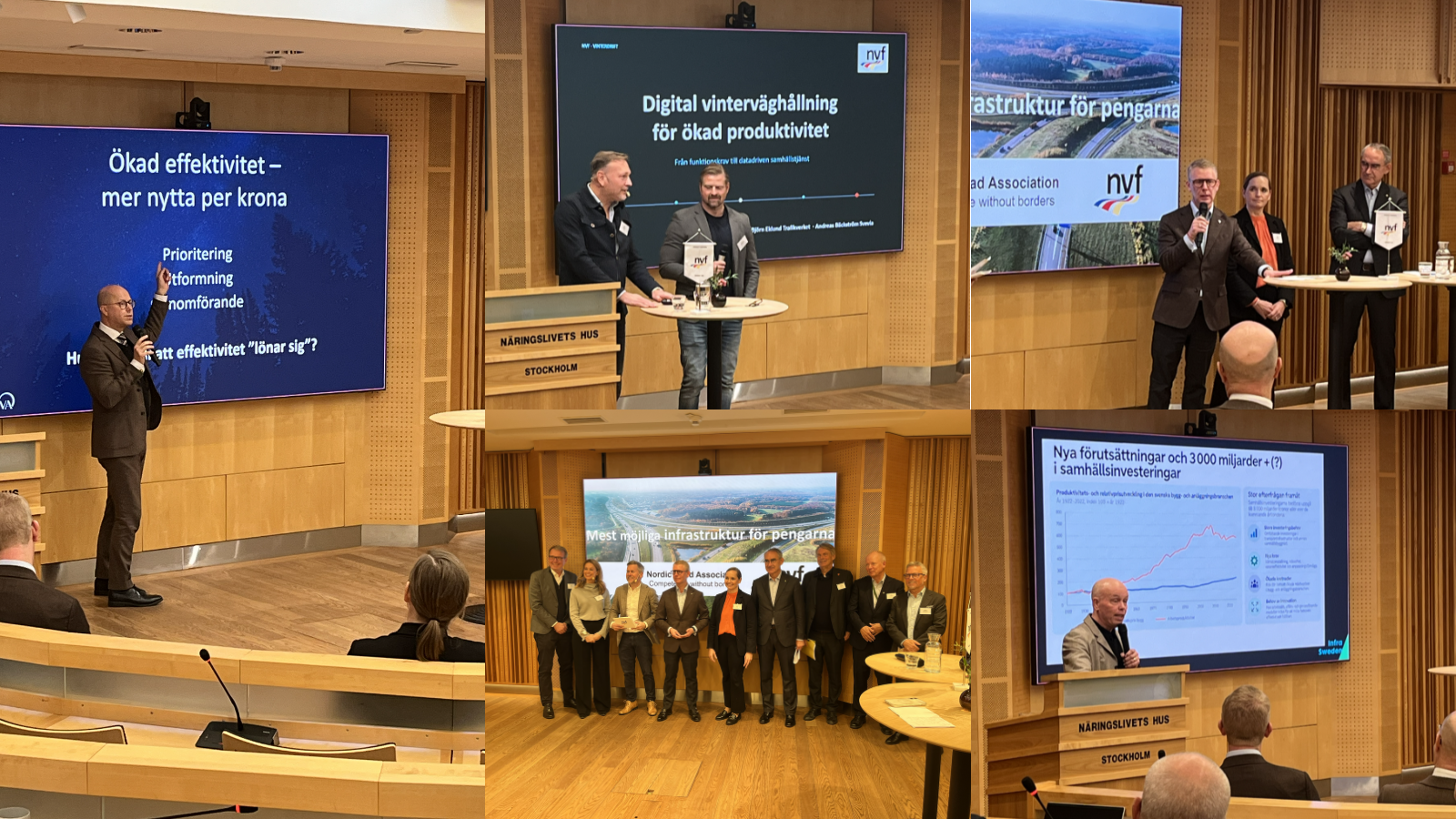
How can the Nordic countries turn major infrastructure investments into more productivity and greater societal benefits? This was the central question when NVF Sweden brought together around 60 representatives from government agencies, industry and academia in Stockholm on 13 October.
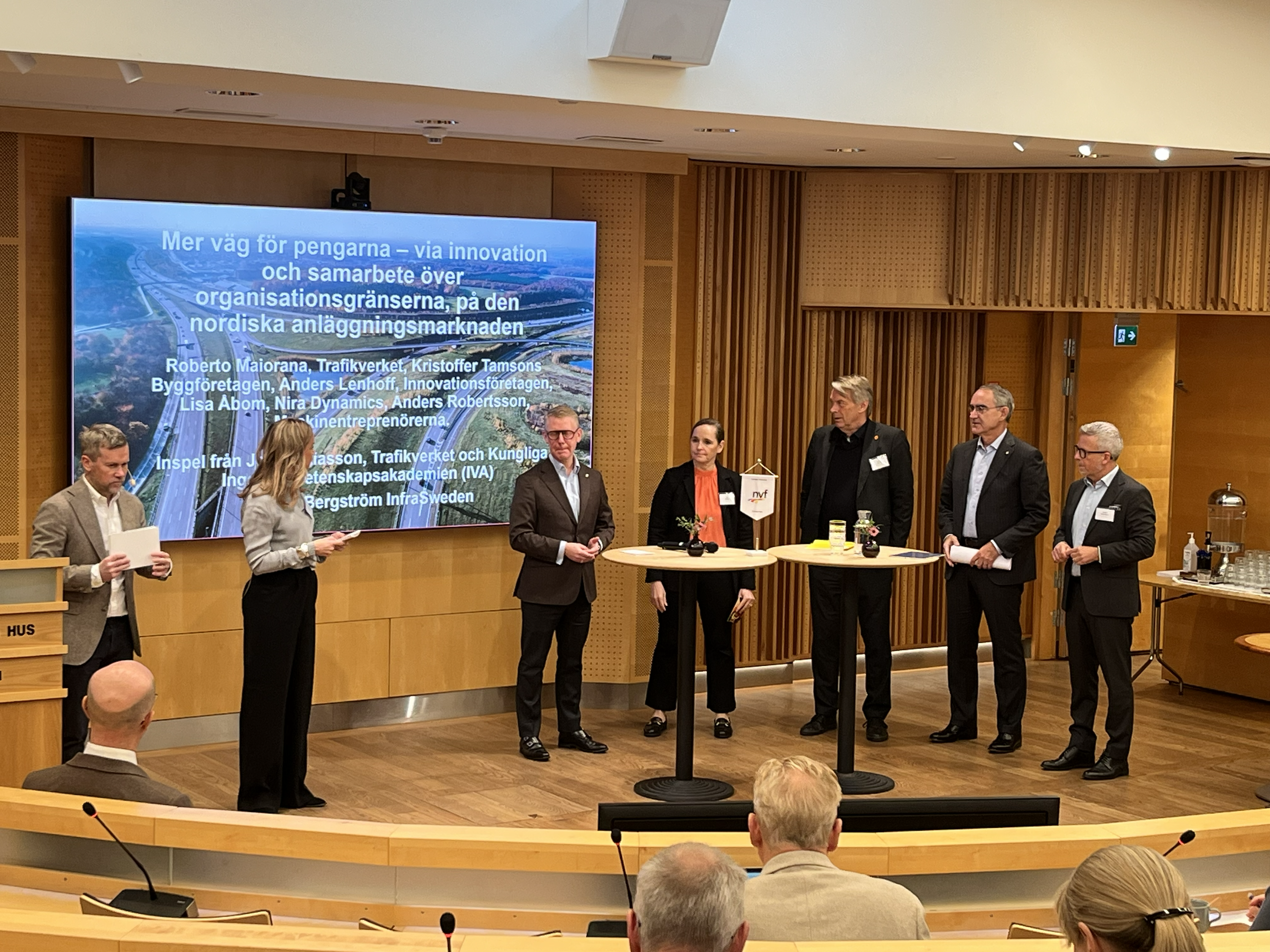
Sweden and its Nordic neighbors face substantial investments in both new and upgraded transport infrastructure, while expectations are rising for productivity, sustainability, competitiveness and preparedness. The seminar Getting More Infrastructure for the Money explored how closer cooperation, innovation and new ways of working can help the sector meet these challenges.
A clear message emerged throughout the day: delivering more value from infrastructure investments requires a long-term, collaborative approach across organisational and national boundaries. New technologies is a key but without effective procurements, the right incentives, systematic evaluation and the ability to scale technologies will end up in the valley of Death rather than successful innovations for the benefit of road users and the society.
Major investments demand clear priorities
Sandra Nordahl from the Swedish Transport Administration (Trafikverket) presented Sweden’s national transport infrastructure plan for 2026–2037, amounting to almost SEK 1,200 billion. The government has also announced an additional SEK 30 billion to address defence-related needs.
With such substantial resources at stake, prioritising investments that deliver the greatest societal benefits is essential. The plan places particular emphasis on road and railway maintenance, while also addressing the need to accommodate heavier and longer vehicles. Expanding the road network for vehicles weighing up to 74 tonnes requires significant bridge upgrades, while further roads are being considered for vehicle combinations of up to 34.5 metres.
The challenge is not simply to invest more, but to ensure that investment decisions, infrastructure design and project delivery together generate the best possible outcomes.
Innovation must move beyond pilot projects
The seminar highlighted the gap between developing promising innovations and implementing them at scale. Fredrik Bergström from InfraSweden and Jonas Eliasson from Trafikverket stressed the need to move from individual innovation projects towards lasting, innovation-driven change across the transport sector.
Digital winter road maintenance offered a practical example of what this can look like. Björn Eklund from Trafikverket and Andreas Bäckström from Svevia described how functional requirements, weather-based payment models and vehicle data can improve productivity and enable more preventive maintenance.
Rather than prescribing detailed methods, functional requirements focus on the road conditions to be achieved. Contractors can choose the vehicles, technologies and methods best suited to delivering the required results and the proper level of service for the people using the roads. Weather-based compensation can also help distribute risks between the client and contractor while encouraging more efficient solutions. As an example, the usage of salt has been reduced by 50% since adopting to the business model based on weather and functional requirements.
The speakers identified opportunities to strengthen Nordic cooperation by sharing experience and aligning requirements, data formats, protocols and measurement methods. A larger, more coherent Nordic market could support comparisons between countries, reduce unnecessary barriers and make it easier to develop and export innovative solutions.
Collaboration and better contracts can unlock productivity
A panel featuring Roberto Maiorana, Director-General of Trafikverket and Chair of NVF Sweden, alongside with Kristoffer Tamson, Byggföretagen, Anders Lenhoff, Innovationsföretagen, Anders Robertsson Maskinentreprenörerna and Lisa Åbom, Nira Dynamics, discussed how the sector can achieve greater value from infrastructure investments.
The discussion pointed to a need to move beyond fragmented responsibilities, project-by-project conflicts and a narrow focus on the lowest initial price. Longer-term relationships, shared objectives and a systems perspective can help improve quality, control costs and accelerate delivery.
Vehicle data is another opportunity. Data from tens of thousands of connected vehicles in Sweden can provide insights into road friction, uneven surfaces, road markings and potentially hazardous driving patterns. Identifying locations with repeated harsh braking or evasive manoeuvres can help road authorities detect risks before accidents occur. Used systematically, such data can support long-term planning and better-targeted maintenance, rather than only responding to immediate problems.
Electrification of construction machinery was also discussed as an opportunity to reduce emissions and improve productivity. However, the transition requires investment, suitable charging infrastructure and predictable demand. Clients, contractors and equipment suppliers need to share risks and create the conditions for investment, while taking operational requirements and the economics of different machines into account.
New procurement models need systematic evaluation
Jörgen Simu from Trafikverket presented ongoing work to develop procurement and collaboration models for a growing infrastructure program, in a market facing shortages of skills and resources.
Nordic countries have different traditions and levels of experience with alliance contracts, design-and-build contracts, public-private partnerships turnkey and traditional contracts. These differences reflect national circumstances, market size, organisational structures and available expertise.
Trafikverket is exploring approaches such as aggregated procurement, geographical packaging, standardisation and collaboration models, including for smaller contracts. The aims are to shorten procurement processes, reduce administration and make better use of knowledge gained from previous projects.
However, the seminar also highlighted an important limitation: there is not yet sufficient evidence to conclude which relationship-based contract models consistently deliver more infrastructure for the money. Stronger performance indicators, systematic follow-up and comparable evaluations are needed to establish what works best in different circumstances.
Preparedness depends on the whole supply chain
Infrastructure resilience and civil preparedness formed another important part of the seminar. Erik Reuterhäll from Trafikverket explained how procurement requirements and long-term agreements can help secure materials, supply chains, personnel and machinery in peacetime, during heightened tensions and in times of crisis.
Since a substantial share of Trafikverket’s activities is delivered through external suppliers, the authority’s ability to maintain and restore transport infrastructure depends on a functioning construction and consulting sector. Preparedness must therefore be integrated into ordinary commercial arrangements, rather than treated as a separate issue.
The possibility of allowing other authorities with critical civil defence responsibilities to use the same framework agreements could also help reduce duplicated procurement, improve access to repair capacity and make more efficient use of public resources.
Nordic cooperation: turning discussion into action
The seminar concluded with a call to translate shared insights into concrete initiatives. NVF’s working groups provide a practical platform for taking this work forward. The Nordic Construction Market group addresses procurement and collaboration models, while a new initiative on operations and maintenance is set to focus specifically on winter road maintenance in a Nordic context.
Across the discussions, several opportunities for further cooperation stood out: sharing proven solutions, developing common approaches where appropriate, strengthening the use of data, evaluating procurement models and creating better conditions for innovation to reach operational scale.
As Roberto Maiorana emphasised, NVF can help bring together stakeholders across organisational and national boundaries. Physical meeting places remain important for building relationships, exchanging experience and identifying opportunities to work together.
The next step is to turn these discussions into practical collaboration. By connecting road authorities, contractors, consultants, technology providers and researchers, NVF can help the Nordic transport sector make better use of its combined expertise and deliver greater societal value from every infrastructure investment.